INTERVIEW OF THE MONTH: ALUMIL YU INDUSTRY
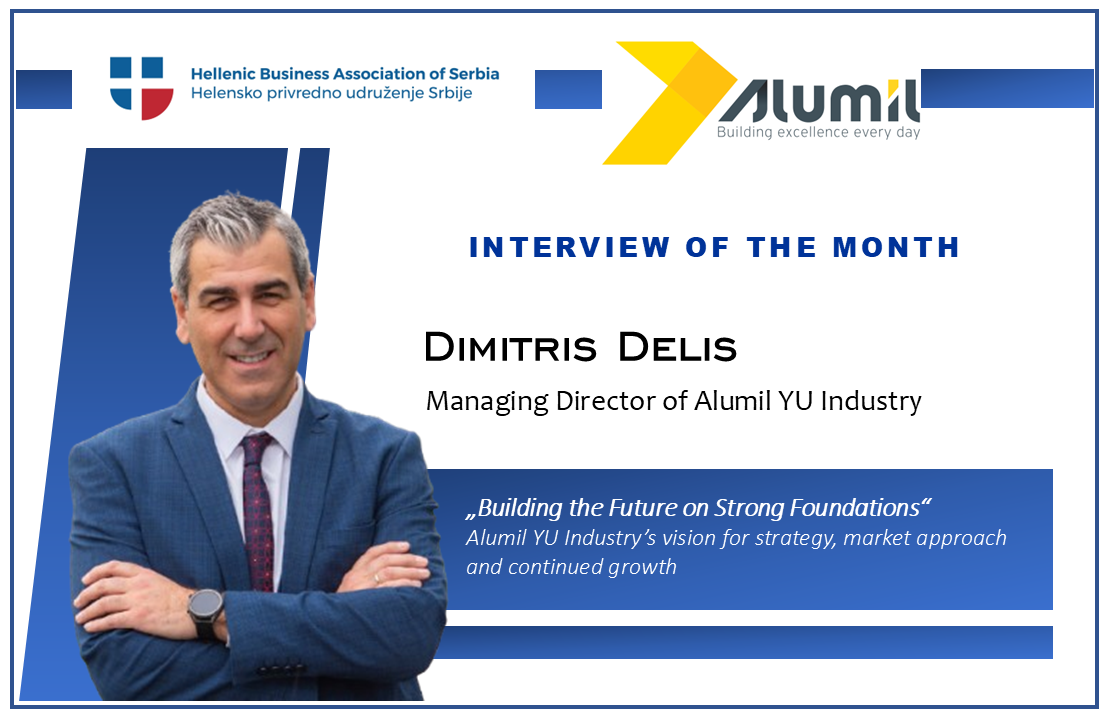
Building the Future on Strong Foundations
Dimitris Delis, Managing Director of Alumil YU Industry
"Our ambition is not to change everything, but to build on this legacy and move it one step forward by combining the strength of an international Group with local understanding - bringing together global know-how with local speed and responsibility"
At the beginning of this year, you took on the position of General Manager of Alumil YU Industry. What key experiences from your career are most important in shaping your approach to this role, and what will be your main focus in the period ahead?
After spending many years close to the market, customers and sales team, I have learned that everything comes down to people, trust, speed and execution.
Taking on the role of General Manager of Alumil YU Industry has given me opportunity to lead the company build on a strong foundation, with a market-leading position, good people and a history of growth. This is something I respect a lot.
My ambition is not to change everything, but to build on this legacy and move it one step forward. Today's market is changing fast, and our focus is to become even more modern, more flexible, and closer to the real needs of customers.
How does Alumil’s international presence shape its approach to the Serbian market and its specific needs?
Our international presence gives us a big advantage. It allows us to leverage global know-how, advanced technologies, proven systems, and experience gained across many different markets.
But we should not assume that one model fits everywhere. Serbia has its own business culture, where strong relationship, speed and pratical solutions for customers are highly valued.
Our approach is to combine the strength of an international Group with local understanding. We want to offer the best of both, global know-how, with local speed and responsibility. This is the balance we need to create long-term value for our partners and continue growing together.
The construction materials and aluminum systems market is competitive and constantly evolving. What are the biggest challenges facing the industry today, and what enables Alumil YU Industry to maintain its leading position in the market?
The market today is very sensitive, with strong competition, price pressure and increasingly demanding customers.
But there is also something bigger happening. The global business environment is less predictable than before. We see how fast the geopolitical map can change — sanctions, trade restrictions, energy challenges, even statements from political leaders can affect markets, supply chains, and customer confidence. Sometimes the market reacts before anything official even happens.
At the same time, climate change is starting to reshape our industry. Buildings will need to perform better in hotter environments, with better energy efficiency, better shading, better fire-rated solutions, and more durable materials.
This is where aluminium has a very strong future. It is light, durable, recyclable, and very suitable for modern building needs.
What keeps Alumil strong is its people, together with the combination of high-quality products, technical expertise, and brand reputation. At the same time, we must remain humble. A strong market position is never permanent and it has to be earned every day through consistent service, reliability, and execution.
Sustainability and energy efficiency have become key priorities in modern construction. How are these trends influencing the company’s product development and overall business strategy?
Sustainability is no longer just a nice word for presentations. It is becoming part of daily business, especially in construction.
Aluminium plays a crucial role here. We see it as a true champion of the circular economy: it can be recycled repeatedly without losing its core properties, making it one of the most sustainable materials for a circular economy. For Alumil, this is not just theory. Initiatives such as Loop 60 and Loop 80—certifications confirming that our aluminium contains at least 60% and 80% recycled material—demonstrate this in practice.
Energy efficiency is also changing product development. Customers want systems that help buildings consume less energy, provide comfort, and support green building certifications. And because the climate is changing, our sector will become even more important. Hotter cities, higher energy costs, fire safety requirements, and the growing demand for better building envelopes will push aluminium systems to the center of modern construction.
The key is to stay practical. Sustainability must create real value — for the customer, the building, and the environment.
As a leader of a company with 400 employees in Serbia, what do you think is the key to building a workplace where people can grow and contribute to the company’s success?
I believe in ownership, teamwork, discipline, and honest communication. A strong workplace is not created by speeches alone, but by leaders who are fair, consistent, and close to their teams. People need guidance, but they also need space to take responsibility.
My goal is to build a culture where people do not wait for someone else to solve the problem, but instead take ownership, cooperate, and continuously improve.
If people grow, the company grows. It is as simple as that.
Recently, you were appointed to the Management Board of the Hellenic Business Association of Serbia. What does this mean to you personally, and how do you see the Association’s role in connecting the Greek business community in Serbia?
It is an honor, but also a responsibility to be appointed to the Management Board of the Hellenic Business Association of Serbia.
Greek companies have a strong presence in Serbia, and there is a long relationship between the two countries. I believe the Association can play an even stronger role in connecting companies, sharing experience, and creating useful cooperation. There is already a strong foundation in place.
Personally, I do not see this only as a title. I see it as a opportunity to contribute, learn from other business leaders, and help build stronger bridges between the Greek and Serbian business communities.